
Hermes Agent Desktop — 20 AI Specialists Collaborate in a Native macOS App
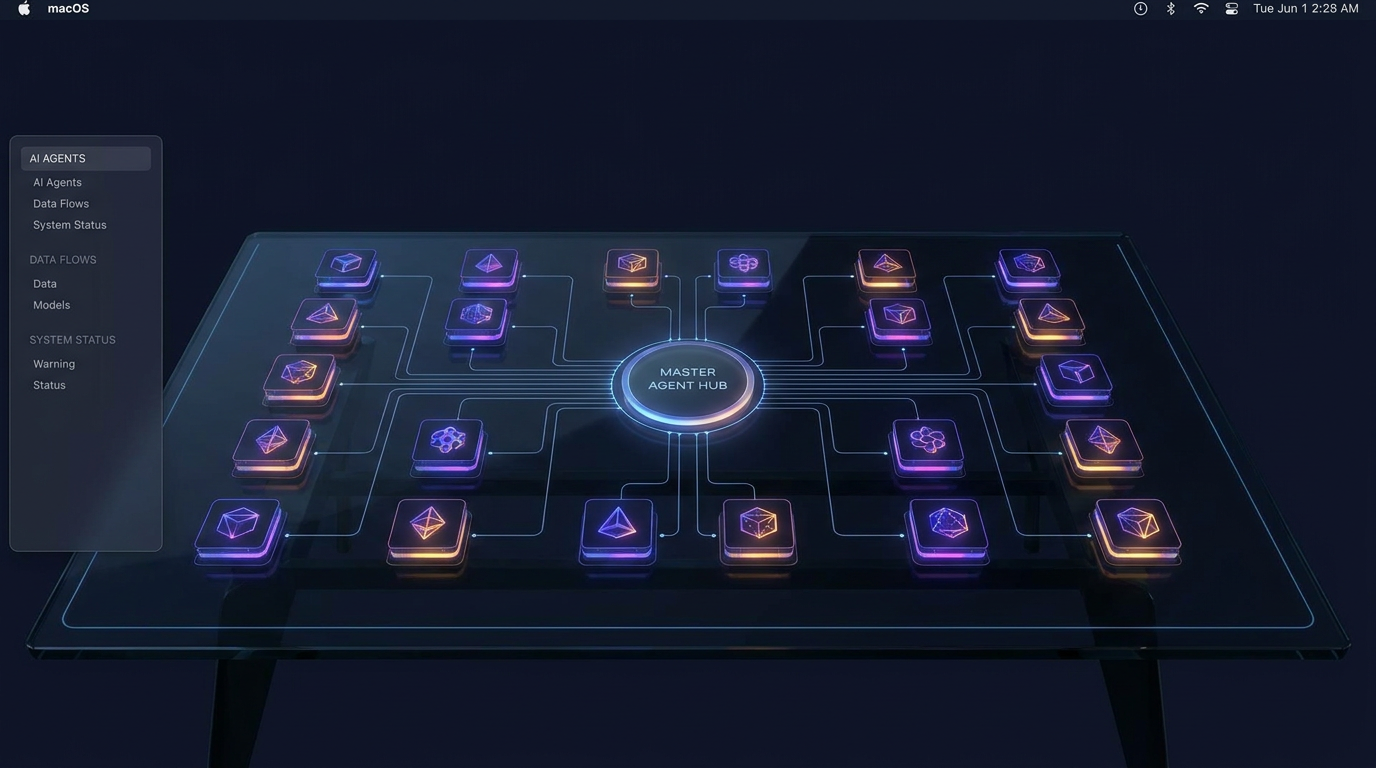
Hermes Agent ships as a terminal application. The CLI is fast and scriptable, but it limits the agent to a single conversation at a time — one agent, one thread, one task. Felix-Forever's hermes-agent-desktop breaks that model open. It is a native macOS desktop client that rebuilds Hermes as a 20-specialist multi-agent system with orchestration, a visual Skill Store, and streaming collaboration — not a GUI wrapper on the CLI, but a ground-up rebuild of the agent experience.
Architecture: From Single Agent to 20 Specialists
The core of the desktop client is a multi-agent orchestration model that maps cleanly to how software teams actually work. Instead of one general-purpose agent reasoning about everything, the system uses a Project Manager agent as the entry point. The PM receives the user's requirement, decomposes it into subtasks, delegates each to the right specialist, tracks progress across all of them, and assembles the final deliverable.
The 20 built-in agents cover the full spectrum of technical work:
| Category | Agents |
|---|---|
| Orchestration | Project Manager, Product Manager |
| Engineering | Frontend Engineer, Backend Engineer, Full-stack Engineer, Architect, DevOps, Data Engineer, AI Engineer, DBA |
| Quality | QA Engineer, Security Expert |
| Design & Content | UI Designer, Creative Director, Tech Writer |
| Business | Marketing, Business Analyst, Operations |
| Specialized | Translator, Legal Counsel |
Each specialist agent has its own system prompt, model assignment, and skill tags. The orchestration flow is linear and predictable:
User describes goal → PM decomposes into subtasks → assigns to specialists → PM synthesizes deliverables
Users do not need to construct multi-step prompts or manually route work to different agents. They describe the goal. The PM handles decomposition and delegation.
What the Desktop Client Brings Over the CLI
The original Hermes CLI is a terminal TUI with a single conversation thread. The desktop client adds five capabilities the CLI does not have:
| Feature | Hermes CLI | Hermes Agent Desktop |
|---|---|---|
| Interface | Terminal TUI | Native macOS GUI (pywebview) |
| Agent model | Single agent, one thread | 20 specialists with orchestration |
| Task handling | Manual prompting | PM auto-decomposes and delegates |
| Skill discovery | hermes skills CLI command |
Visual Skill Store, one-click install |
| Model switching | Config file edit | One-click switcher in UI |
The client uses pywebview for its native window, not Electron. This matters for resource usage — pywebview uses the system's built-in WebKit on macOS (or Edge WebView2 on Windows), avoiding the memory overhead of bundling an entire Chromium instance. For an app that may run 20 agents concurrently, avoiding Electron's baseline memory footprint is a practical concern.
The Skill Store
The integrated Skill Store sources skills from the CocoLoop Skill Hub, offering 50+ curated, one-click-install skills with category tags covering development, productivity, security, search, and agent orchestration. The store includes fuzzy search across both skill names and descriptions, with real-time filtering and install confirmation.
In the CLI workflow, discovering and installing skills requires leaving the terminal: browsing GitHub repositories, reading README files, and manually copying skill directories into ~/.hermes/skills/. The desktop client collapses that into a single UI interaction.
Streaming Chat and Multi-Agent Visibility
The chat interface handles streaming SSE responses with typing cursor animation and clearly labeled multi-agent response sections. When the PM delegates to specialists, each agent's output appears in its own labeled section, making it possible to trace which specialist produced which part of the final deliverable.
Rich markdown rendering covers syntax-highlighted code blocks with copy buttons, tables, blockquotes, and lists. Tool call indicators appear as collapsible panels, letting users inspect or hide the agent's tool-use decisions without cluttering the conversation view.
Agent management is handled through a full CRUD dashboard with live status indicators. Each agent can be assigned a custom system prompt, model, and skill tags independently — a frontend engineer can run on a coding-optimized model while the UI designer uses a model tuned for creative output, all within the same task.
Model Support
The client supports a range of providers without requiring config-file edits:
- Kimi K2.5
- Qwen Plus and Qwen Max
- DeepSeek V3 and DeepSeek R1
- GPT-4o and other OpenAI-compatible endpoints
Model selection happens in the input area with a dropdown, not in a YAML file. The API endpoint, key, and model are configurable through a settings panel.
Installation
The project installs in five steps on macOS:
git clone https://github.com/Felix-Forever/hermes-agent-desktop.git
cd hermes-agent-desktop
git clone --depth 1 https://github.com/NousResearch/hermes-agent.git hermes-core
python3.11 -m venv venv && source venv/bin/activate
pip install -e "./hermes-core[all,dev]" pywebview
python app.py
The desktop client depends on the core Hermes Agent repository as a submodule — it does not fork or replace the agent engine. It builds a collaboration layer on top of it.
What This Signals
The Hermes agent protocol — tools, skills, memory, gateway hooks — was designed to be extensible. This desktop client is an example of what that extensibility enables at the application layer: a completely different interaction model (multi-agent orchestration) built on the same agent runtime that powers CLI sessions and cron jobs.
The community has built at least two desktop clients on Hermes in the past month: Felix-Forever's multi-agent system and fathah/hermes-desktop, a companion app focused on easier multi-profile management and migration from OpenClaw. Both demonstrate that the agent's plugin and hook architecture is sufficiently general to support radically different front-ends without modifying the core.
[^1]: Felix-Forever. "hermes-agent-desktop: Multi-Agent AI Desktop Client." GitHub. May 2026.
[^2]: 0xMarioNawfal (@RoundtableSpace). "HERMES AGENT JUST LAUNCHED A DESKTOP APP THAT LETS YOU RUN MULTIPLE AUTONOMOUS AI AGENTS AT SCALE FROM ONE INTERFACE." X. May 26, 2026.
[^3]: WorldofAI. "Hermes Agent NEW Desktop App — The 24/7 Self-Evolving AI Agent." YouTube. May 10, 2026.